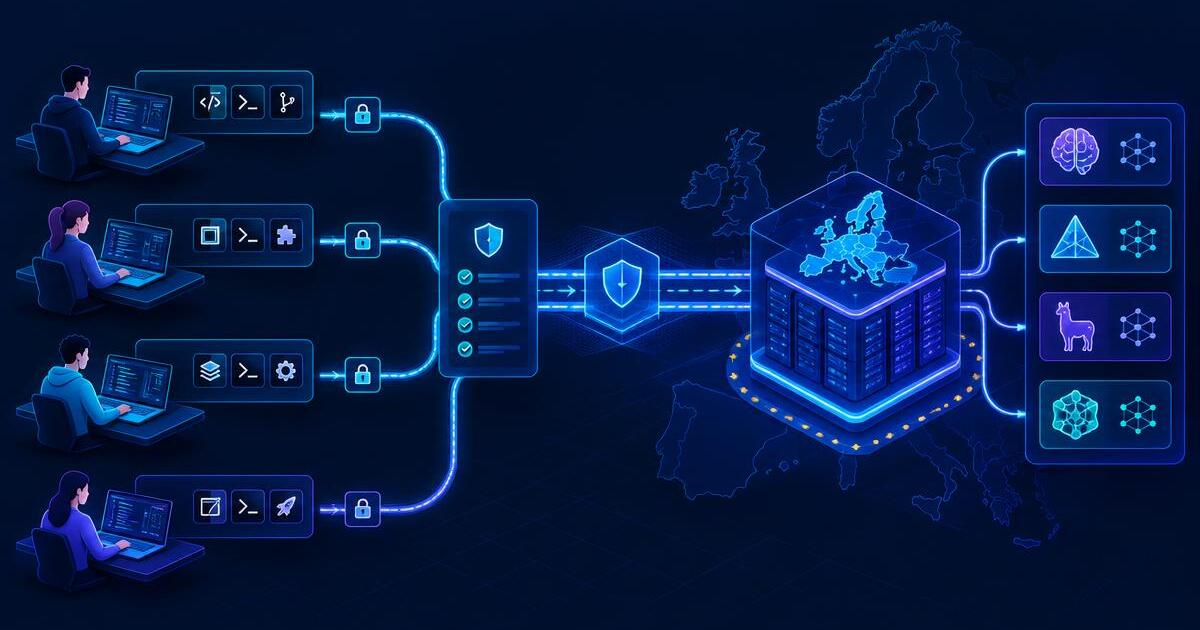

Claude isn’t the only way to get a capable coding model in the EU. Open-weight models from Qwen, Google and Mistral can run in EU Regions on AWS, on European platforms, or on hardware you control. For some teams that matters because Claude cannot be self-hosted and is not currently available on the AWS European Sovereign Cloud.
When I looked beyond Claude, I expected “open weight” to make the residency question simpler. It does in one sense: you can run the weights yourself. But the hosted options are surprisingly uneven across Regions, versions and licences.
Models I would evaluate now
The licence and lifecycle status matter as much as the benchmark. For a new Mistral deployment, Medium 3.5 is the active open-weight model Mistral points new integrations to; the older Devstral 2 and Devstral Small 2 releases are deprecated.
| Model family | Made by | Licence | Notes |
|---|---|---|---|
| Qwen3 Coder (30B, 480B, Next) | Qwen, Alibaba Cloud | Apache 2.0 for Qwen3 Coder 30B (Qwen: licence) | Coding-specialised models with a 256K-token context window on Bedrock (AWS: Qwen3 Coder 30B model card) |
| Gemma 4 (31B, 26B-A4B, E2B) | Google DeepMind | Apache 2.0 (AWS ML blog) | AWS describes Gemma 4 31B as suited to reasoning- and coding-heavy work (AWS What’s New) |
| Mistral Medium 3.5 | Mistral AI | Modified MIT, with additional conditions for some high-revenue companies | Active open-weight model recommended by Mistral for new integrations. Enterprise users should review the current licence terms. |
| Devstral 2 / Devstral Small 2 | Mistral AI | Deprecated | Older coding models. Keep only for existing/self-hosted deployments where you have a reason; use Mistral Medium 3.5 for new integrations. |
| Codestral | Mistral AI | Mistral AI Non-Production Licence (Mistral docs) | Weights are available, but production use needs a commercial agreement or Mistral’s API |
Read each licence yourself before deploying. “Open-weight” covers everything from Apache 2.0, which lets you use the model freely, to licences that don’t allow production use at all.
Running them on AWS in the EU
Amazon Bedrock
Bedrock is the simplest route: AWS runs the model, you pay per token, and you use the same IAM, CloudTrail and billing as for Claude. But check each model’s Regions carefully, because they differ a lot.
- Qwen3 Coder 30B runs In-Region in Frankfurt, Stockholm, Milan and Ireland. There are no Geo or Global profiles, so each request stays in the Region you call (AWS: Qwen3 Coder 30B model card).
- Qwen3 Coder Next, the newer model, is currently In-Region only in N. Virginia, London and Sydney (AWS: Qwen3 Coder Next model card). London is in Europe but not in the EU, so on your own Bedrock account this model isn’t available in an EU member state today.
- Gemma 4 is available in Europe (Frankfurt) as well as three US Regions (AWS What’s New). It’s served only through the bedrock-mantle endpoint (AWS: Gemma 4 31B model card).
A useful detail for coding tools: Bedrock offers an OpenAI-compatible
Chat Completions API for these models. For Qwen, you point an
OpenAI-compatible client at
https://bedrock-runtime.<region>.amazonaws.com/openai/v1 with a
Bedrock API key (AWS: Qwen3 Coder 30B model
card).
For Gemma 4, the base URL is
https://bedrock-mantle.<region>.api.aws/openai/v1 (AWS: Gemma 4 31B
model
card).
Use an EU Region in that URL and the request stays there.
The AWS European Sovereign Cloud
If you need sovereign operations, not just EU residency, Gemma 4 is the first open-weight model family on Bedrock in the AWS European Sovereign Cloud, served through the bedrock-mantle endpoint (AWS Security blog). At the time of writing, it’s the only open-weight model family AWS has announced there.
Hosting the model yourself on AWS
Because the weights are published, you can also run these models on GPU instances in an EU Region and keep everything inside your own account. Qwen’s own model page shows the model served with vLLM, which exposes an OpenAI-compatible API (Qwen: Qwen3 Coder 30B). The trade-off is that you now run the GPUs, the scaling and the patching yourself, and you pay for capacity whether or not anyone is coding.
Running them in the EU outside AWS
Mistral’s own platform
Mistral’s API platform, La Plateforme, is hosted and served on Mistral’s infrastructure in Europe, and Mistral is a French company. For new integrations, Mistral currently points developers to Mistral Medium 3.5, an active open-weight model under a Modified MIT licence. That licence includes additional conditions for some high-revenue companies, so enterprise users should review the current licence rather than treating it as ordinary MIT. The older Devstral 2 and Devstral Small 2 releases are deprecated, although their published weights can still matter for existing or self-hosted deployments. As with any vendor, check the current subprocessor list before approving sensitive code.
Your own servers or an EU hosting provider
With a permissively licensed open-weight model such as Qwen3 Coder 30B, Gemma 4 or Mistral Medium 3.5, you can run the weights on infrastructure you choose, subject to the model’s licence terms. That can mean your own data centre, an EU hosting provider or cloud GPU instances. Always read the exact licence for the version you deploy.
This gives you the strongest control over where code goes, including fully disconnected setups. It also gives you the most work: sizing GPUs, serving the model, keeping it updated, and securing the endpoint so that it doesn’t become the weak point. If you use a hosting provider, their location, ownership and subprocessors become part of your compliance analysis in the same way AWS’s are.
The options side by side
| Where it runs | Example models | EU processing | Sovereign operations | Who runs it |
|---|---|---|---|---|
| Bedrock, EU Region, your account | Qwen3 Coder 30B, Gemma 4 | Yes, In-Region | No | AWS |
| Bedrock, AWS European Sovereign Cloud | Gemma 4 | Yes | Yes | AWS, EU-resident staff |
| Kiro with a Frankfurt profile | Qwen3 Coder Next and others | Yes, across Kiro’s EU Regions (Kiro: Models) | No | AWS |
| Mistral’s platform | Mistral Medium 3.5 and other active Mistral models | Yes, hosted in Europe | EU vendor | Mistral |
| Your own GPUs, on AWS or elsewhere in the EU | Any model whose licence allows it | Yes | Depends on where you host | You |
One detail from that table surprised me: Qwen3 Coder Next isn’t offered in an EU member state on your own Bedrock account, but Kiro serves it from the EU for Frankfurt profiles. Availability depends on the route, not just the model.
How to choose
- You need sovereign operations: Gemma 4 on the AWS European Sovereign Cloud, or self-hosting in the EU.
- You want an EU vendor as well as EU processing: Mistral’s platform.
- You’re already on AWS and want the least operational work: Bedrock in an EU Region, with the same IAM and CloudTrail controls you’d use for Claude.
- You need a disconnected or on-premises setup: a self-hosted Apache 2.0 model.
Whichever you pick, test it on your own code before committing. Open-weight models vary a lot in how well they handle agentic coding tasks, and your codebase is a better benchmark than any leaderboard.
Choosing between managed and self-hosted?
Wolkn Minds can help benchmark the models on your own code, then design the EU deployment on Bedrock, a sovereign environment or infrastructure you control.
Sources
- Amazon Bedrock: Qwen3 Coder 30B model card
- Amazon Bedrock: Qwen3 Coder Next model card
- Amazon Bedrock: Gemma 4 31B model card
- AWS What’s New: Gemma 4 models now available on Amazon Bedrock
- AWS ML blog: Introducing Gemma 4 models on Amazon Bedrock
- AWS Security blog: Run open-weight models on Amazon Bedrock in the AWS European Sovereign Cloud
- Kiro: Models
- Qwen: Qwen3 Coder 30B licence and model page
- Mistral AI: Mistral Medium 3.5
- Mistral AI: La Plateforme
- Mistral docs: Model lifecycle and open-weight models
- Mistral docs: Devstral 2 / Devstral Small 2 deprecation notices