
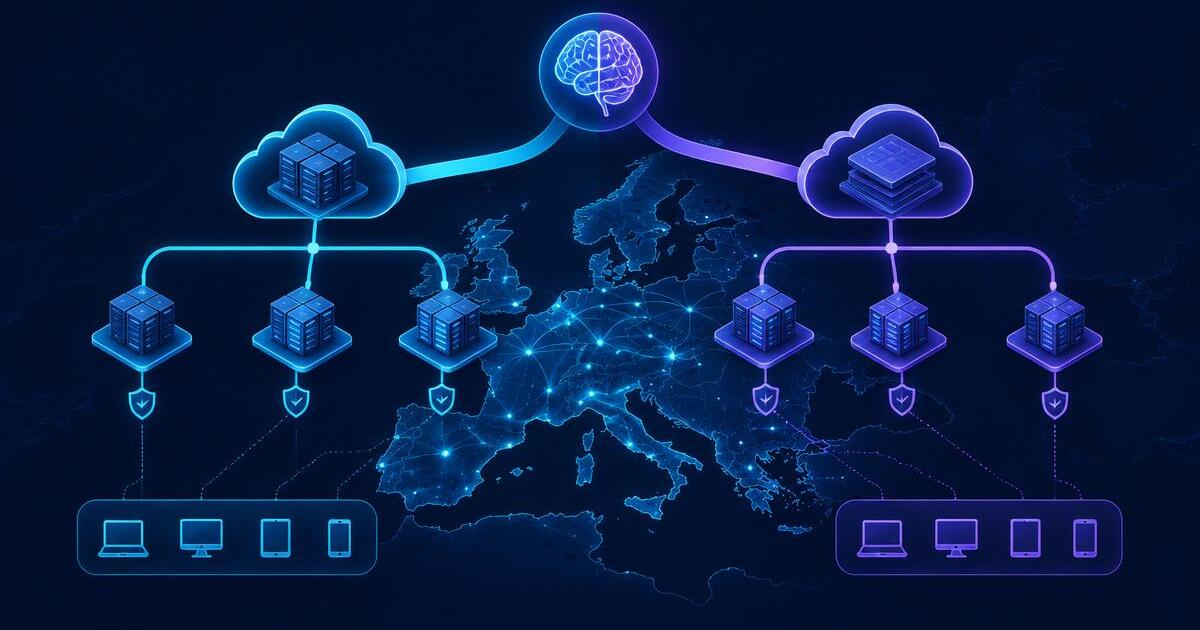
Both put Claude on your AWS bill, and both use IAM for access. To a procurement team they look almost identical. To your DPO, they’re very different services.
The difference is who runs them. On Amazon Bedrock, AWS operates inference and is the data processor. On Claude Platform on AWS, Anthropic operates it and is the processor for your prompts and responses (Anthropic: Claude Platform on AWS). Today, only Bedrock can keep processing in the EU.
What each one is
Claude on Amazon Bedrock runs on AWS-operated infrastructure. AWS states that Anthropic personnel do not have access to Bedrock customer prompts or completions, and Bedrock governs the inference environment and its AWS-native controls (Anthropic: Claude in Amazon Bedrock).
Claude Platform on AWS is Anthropic’s own platform with AWS in front of it. AWS handles authentication, IAM access control and billing through AWS Marketplace, while Anthropic runs the service (AWS: What is Claude Platform on AWS?). Anthropic describes it as an Anthropic-operated option on AWS that typically gets new features the same day (Anthropic: Claude in Amazon Bedrock), including code execution, the Files API and batch processing (AWS: What is Claude Platform on AWS?).
One recent change is worth knowing about. For workspaces created from 18 September 2026, Anthropic uses AWS infrastructure to process requests and store workspace content. Older workspaces may be processed outside AWS (Anthropic: Claude Platform on AWS). Either way, Anthropic is still the operator and the processor.
Side by side
| Question | Claude on Amazon Bedrock | Claude Platform on AWS |
|---|---|---|
| Who operates inference | AWS | Anthropic |
| Processor of prompts and responses | AWS | Anthropic |
| EU processing | Yes, for supported models via EU profiles or In-Region | No: inference_geo supports US or Global, and defaults to Global |
| Cost of pinning a geography | About 10% more than Global | 1.1x for inference_geo: "us" on Claude 4.6 and later |
| New models and features | Often later, and some features aren’t supported | Typically the same day as the Claude API |
| Server-side tools such as code execution | Not supported | Supported |
| Access control | AWS IAM | AWS IAM |
| CloudTrail for inference calls | Logged by default | Data events: you have to turn them on, at extra cost |
| Billing | AWS bill, under the model provider | AWS bill, as Claude Consumption Units |
Sources: AWS: Claude Platform on AWS data residency, Anthropic: Pricing, Anthropic: Claude Platform on AWS, Anthropic: Claude in Amazon Bedrock, AWS Alps blog.
The CloudTrail row catches people out. On Claude Platform on AWS, workspace and key operations are logged by default, but inference, batch and file operations are data events. You have to switch those on yourself, and they cost extra (Anthropic: Claude Platform on AWS). If you’re relying on CloudTrail as evidence, set that up before you go live.
Which one to use, and when to use both
It comes down to one question: do you need AWS to be the processor of your data, or do you want Anthropic’s full platform inside your existing AWS relationship? AWS’s own documentation is clear that with Claude Platform on AWS, data may not stay in AWS and inference may be routed to Anthropic’s primary cloud (AWS: What is Claude Platform on AWS?).
Use Bedrock for personal data, regulated data, customer documents and source code that fall under an EU residency requirement, and anywhere your DPO needs AWS as the processor.
Use Claude Platform on AWS for work that isn’t bound by EU residency and benefits from getting new features first. Good examples are prototyping with synthetic data, internal tools using approved non-sensitive data, and features like code execution that Bedrock doesn’t offer.
Many organisations run both. Classify workloads by how sensitive their data is, send each one to the right option, and make that rule enforceable. For example, allow Claude Platform on AWS only in accounts that never hold personal data, and keep production data accounts on Bedrock with EU-only IAM and SCPs, as described in How to Enforce EU-Only Claude Routing with IAM and SCPs.
Trying to decide which path belongs where?
Wolkn Minds can help classify the workloads, design the Bedrock and Platform patterns, and put the controls around each one so the decision is enforceable rather than just documented.